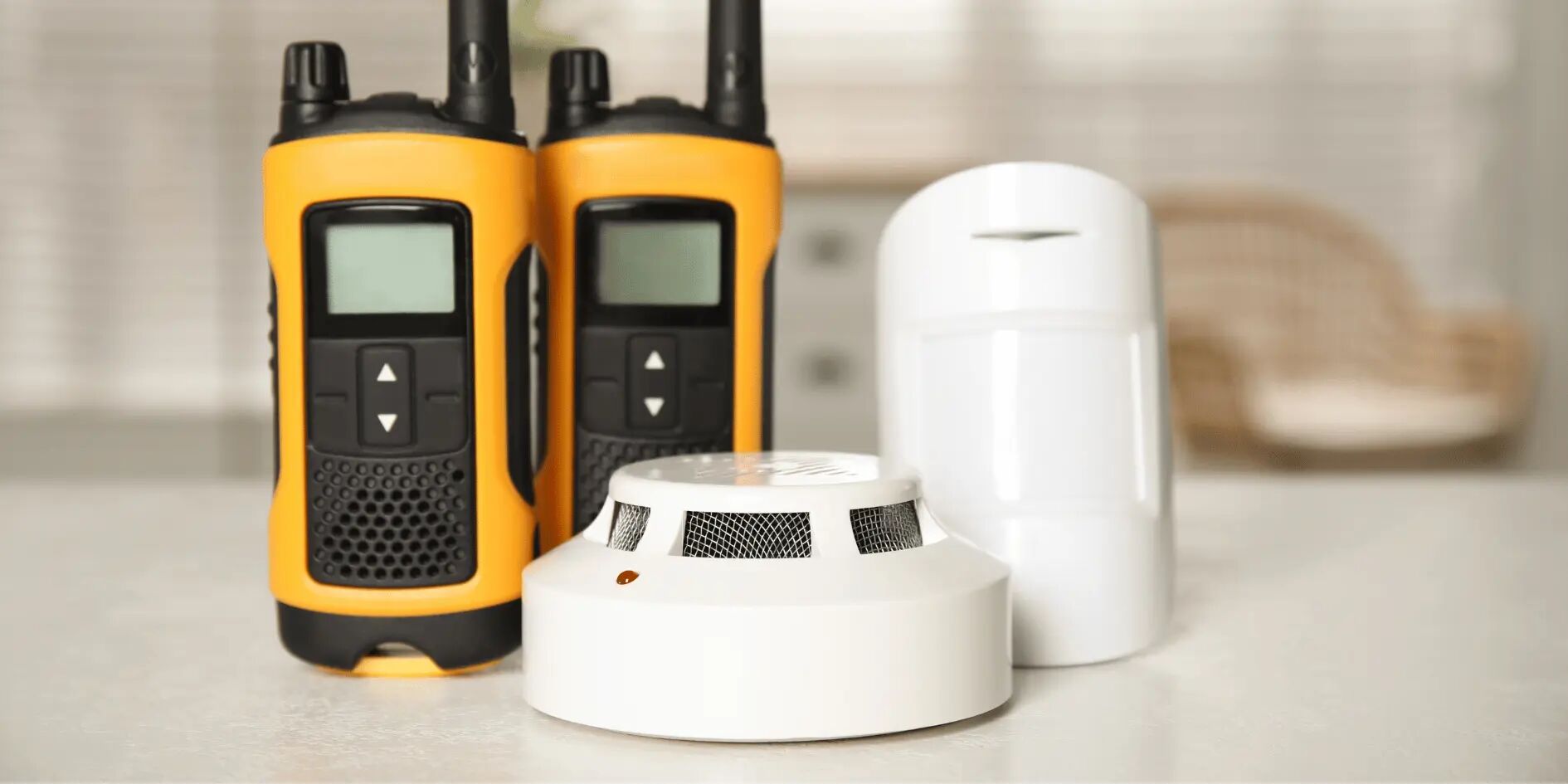

A fire detector is a device designed to sense one or more physical signs of a fire, including smoke, heat, or flames. Its main purpose is to inform the fire alarm panel and ensure people evacuate the property before the fire spreads. Such devices are an integral part of every fire detection system because the alarm panel is dependent on its detectors when no person is around to report the fire. However, not every fire starts in the same way.
For example, an overheated cable in an office keeps giving off smoke for a long time before any flame appears. Still, a flammable liquid fire in a factory grows into open flames within seconds and leaves very little time to react. That's why fire detectors are available in many types. In India, the right type for each area is selected as per IS 2189:2026, the Indian Standard for fire detection and alarm systems.12
In this article, we will discuss the Types of Fire Detectors in detail. Let us understand the role of a detector in a fire detection and alarm system, how fire detectors are classified, how each type works, what causes false alarms, and how to choose the right one for your facility.
What is a Fire Detector?
A fire detector is commonly known as a fire sensor. It is an electronic device fixed on the ceiling or the wall, where it keeps looking for a sign of fire, such as smoke or a rise in temperature. Once the reading crosses the set value, the detector alerts the fire alarm panel of the active fire protection system.
Please note that it differs from the battery-operated smoke alarm sold for homes. Such an alarm sounds its own buzzer. A fire detector usually has no sounder, so it is dependent on the panel and hooters for alarming the occupants.
In Maharashtra, Section 45A of the Maharashtra Fire Prevention and Life Safety Measures Act, 2006 allows only a Licensed Fire and Life Safety Auditor to conduct the fire audit, and PowerTech holds this licence.3 During the audit, we check whether every area has a detector which suits its risk.
Role of Fire Detectors in a Fire Detection and Alarm System
In general, a fire detection and alarm system works in two halves. The alarm half is dependent on the detection half, so the panel stays silent until a detector or a manual call point has reported the fire to it.
Below are the things which wait for this signal:
- Hooters and the evacuation message
- The air-conditioning fans, which have to stop so that the ducts do not spread smoke
- Gas suppression system of a server room
As such, the type of detector plays a vital role in how early the signal arrives. As per IS 2189:2026, a fire generally gives off detectable smoke before detectable heat, so a heat detector in a hotel bedroom responds only after the fire has grown, and everything listed above starts late.1
To learn more about fire detection systems in detail, please read our article: What is a Fire Detection System?
How are Fire Detectors Classified?
Fire detectors are classified in three ways. For example, a fire alarm quotation may carry a line such as "addressable multi-criteria detector, point type", where multi-criteria is what the detector senses, point type is the area it covers, and addressable is the way it is connected to the panel.
Below are the three ways fire detectors are classified:
- By What They Sense: Describes the sign of fire which the detector reads, such as smoke or heat.
- By Coverage: Indicates how much area one detector protects, from a single spot on the ceiling to a line as long as 100 metres.
- By Connection to the Panel: Tells how the detector is wired to the panel, or whether it uses a radio link instead.
Please note that the manual call point is not a fire detector, because a person operates it.
Types of Fire Detectors
Types of Fire Detectors by What They Sense
It is the most familiar classification, and IS 2189:2026 also groups the detectors in the same way.1
1. Smoke Detectors
A smoke detector looks for smoke particles. Its optical type, also known as the photoelectric type, operates when the smoke entering the chamber scatters light onto a sensor, and the older ionisation type carries a tiny radioactive source as per the code.1 Ideal for areas where people work or sleep.
2. Heat Detectors
A heat detector operates either at a fixed temperature or when the room heats up faster than normal, which is called the rate-of-rise type. It takes longer to respond than a smoke detector.1 Ideal for kitchens and generator rooms, where fumes are a part of the daily work.
3. Flame Detectors
A flame detector picks up the radiation of the flame in the ultraviolet (UV) or the infrared (IR) band, and as per IS 2189:2026, a UV detector can respond within milliseconds.1 The spark or ember detectors used in dust ducts belong to the same group. Ideal for the fuel stores and paint shops of a factory.
4. Multi-criteria and Carbon Monoxide Detectors
A multi-criteria detector, also known as a multi-sensor detector, judges the readings of two or more sensors together, such as smoke with heat, which results in fewer false alarms. A carbon monoxide (CO) detector suits the sleeping areas as per the code, but it can not notice an overheating cable early.1
5. LPG and PNG Gas Leak Detectors
A gas leak detector senses the leaked cooking gas. IS 2189:2026 covers it as well, and the LPG version is fixed near the floor since LPG (liquefied petroleum gas) is heavier than air, with the PNG (piped natural gas) version near the ceiling.1 Ideal for commercial kitchens and flats with piped gas.
Types of Fire Detectors by Coverage
The same sensor comes in different forms, as per the size and shape of the area.
1. Point Type Detectors
A point type detector, also known as the spot type, protects only the circle around itself. As per IS 2189:2026, no part of a room should be farther than 7.5 metres from a smoke detector or 5.3 metres from a heat detector, and above a 10-metre ceiling, only the beam or aspirating types are allowed.1
2. Beam Detectors
A beam detector, the line-type version of a smoke detector, sends an optical beam to a receiver on the opposite wall and operates when the rising smoke blocks a part of it. As per the code, one set covers 10 to 100 metres of a warehouse or an atrium.1
3. Linear Heat Detectors
A linear heat detector is a heat-sensing cable, which is laid along the risk itself and raises the alarm when any point on its length gets overheated. Most engineers call it the LHS (linear heat sensing) cable. Ideal for the cable trays and conveyors of a factory.
4. Aspirating and Duct Smoke Detectors
An aspirating smoke detector (ASD), also known as an air sampling detector, keeps pulling the room air through sampling pipes into a very sensitive chamber, which makes it ideal for data centres. The duct smoke detector does the same inside an air-conditioning duct, and its signal stops the fans.
Types of Fire Detectors by Connection to the Panel
Most of the above detectors are available in three versions, as per the way they are connected to the panel.
1. Conventional Detectors
A conventional detector sits on a shared circuit, called a zone, which takes up to 20 detectors as per IS 2189:2026.1 When it operates, the panel shows only the zone number, and the staff has to find the detector whose red light is on, so it suits small buildings only.
2. Addressable Detectors
An addressable detector carries its own address. As such, the panel shows the exact room in which it has operated, and most of the panels also warn the maintenance team when its chamber is getting dirty. Ideal for multi-storey buildings such as malls and hospitals.
3. Wireless Detectors
A wireless detector runs on its own battery. It reports to the panel over a radio link, so no cable is laid up to it. IS 2189:2026 has a new clause for such systems, which names heritage buildings and retrofit works among their uses.1
Quick Comparison Table of All Fire Detector Types
Below is a quick comparison of all the fire detector types we discussed above. It also gives the part of the IS/ISO 7240 series for each type, which is the product standard for fire detectors in India.2
| Detector | Senses | Coverage | IS/ISO 7240 Part | Application |
|---|---|---|---|---|
| Smoke | Smoke | Point | Part 7 | Offices, bedrooms, corridors |
| Heat | Heat | Point | Part 5 | Kitchens, generator rooms |
| Flame | UV or IR radiation | Field of view | Part 10 | Fuel stores, paint shops |
| Multi-criteria | Smoke with heat | Point | Part 15 | Areas prone to false alarms |
| Carbon Monoxide | CO gas | Point | Part 6 | Sleeping areas |
| Gas Leak | LPG or PNG | Point | Not in the series | Commercial kitchens |
| Beam | Smoke | Line, 10 to 100 m | Part 12 | Warehouses, atriums |
| Linear Heat | Heat | Line, along the cable | Part 31 (resettable type) | Cable trays, conveyors |
| Aspirating | Traces of smoke | Room air through pipes | Part 20 | Data centres |
| Duct | Smoke | Air inside a duct | Part 22 | Air-conditioning ducts |
Please note that the wireless detectors also follow Part 25 of the same series, which covers the components working on a radio link.2
Common Causes of False Alarms in Fire Detectors
A false alarm is an alarm without a fire. In most cases, the detector is not faulty, and it is only reading something which looks like a fire to its sensor. Below are the most common causes:
- Cooking Fumes and Steam: A smoke detector near a kitchen or a bathroom reads them as smoke, so a heat or multi-criteria detector suits such places.
- Dust and Insects: Both enter the sensing chamber, especially during renovation work, so the detectors need regular cleaning.
- Sunlight and Arc Welding: As per IS 2189:2026, they can confuse a flame detector, and the combined UV/IR type reduces this problem.1
- Ageing Detectors: An old detector often becomes over-sensitive, so get its sensitivity tested through the maintenance contractor.
As such, after a few false alarms, someone usually switches off the detector, or the complete zone, at the panel, and the area remains without any detection until the next audit finds it.
How to Choose the Right Fire Detector
Choosing a fire detector must not feel like a difficult job, as the area itself decides the type. Check the following four things:
- The Fire You Expect: Ask what will burn first. Cables and furniture smoulder for a long time, which calls for smoke detectors, and fuels or solvents call for flame detectors.
- Ceiling Height: As per IS 2189:2026, point-type detectors are not allowed above 10 metres, so a tall hall needs beam or aspirating detectors.1
- Sleeping Areas: Keep heat detectors out of bedrooms and wards, as the code does not accept them where lives depend on an early warning.1
- Electrical Rooms: The BMC (Mumbai) attributes 70 to 80% of the city's fires to faulty electrical connections, so the panel rooms and cable trays deserve the earliest detection.4 At PowerTech, a Chartered Electrical Safety Engineer (CESE), authorised by the Government of Maharashtra under Regulation 6 of the Central Electricity Authority (Measures relating to Safety and Electric Supply) Regulations, 2023, inspects them during the Electrical Safety Audit.5
Conclusion
In most cases, a building needs more than one type of detector. A single office tower may need smoke detectors on the floors, heat detectors in the pantry and a beam detector across the atrium. The selection also goes stale with time, as a storeroom turns into a server room or a new partition blocks a detector, so it is better to get the same checked after every fit-out.
PowerTech works out of Pune, Mumbai and Nashik. Since 2014, our engineers have been conducting safety and energy audits. We hold the Fire & Life Safety Auditor licence MF&ES/F&LSA/0029 from the Directorate of Maharashtra Fire & Emergency Services, and the auditor whose name it carries conducts the fire audit in person. Contact our team of licensed auditors today to find out whether every area of your building has the right type of detector.
References
- (March 2026). IS 2189:2026, Selection, Installation and Maintenance of Automatic Fire Detection and Alarm System, Code of Practice (Fifth Revision). Bureau of Indian Standards (copy hosted by the National Safety Council of India). https\://nsc.org.in/assets/img/safetyconnect/pdf/FIRE-DETECTORS.pdf
- (2026). Programme of Work, CED 22: Fire Fighting. Bureau of Indian Standards. https\://www.services.bis.gov.in/php/BIS_2.0/bisconnect/pow_new/Pow/download_pow_pdf_dept_commtt/63/202/
- (2023). The Maharashtra Fire Prevention and Life Safety Measures Act, 2006 (Mah. III of 2007), as amended. Directorate of Maharashtra Fire and Emergency Services. https\://mahafireservice.gov.in/directorate/fire-act/2006/Maharashtra%20Fire%20Prevention%20and%20Life%20Safety%20Measures%20Act,%202006..pdf
- (January 19, 2022). Mumbai: Short circuit caused 75% of fires over past five years, says Fire Brigade chief Hemant Parab. Free Press Journal. https\://www.freepressjournal.in/mumbai/mumbai-short-circuit-caused-75-of-fires-over-past-five-years-says-fire-brigade-chief-hemant-parab
- (June 8, 2023). Central Electricity Authority (Measures relating to Safety and Electric Supply) Regulations, 2023. Central Electricity Authority. https\://cea.nic.in/regulations-category/measures-relating-to-safety-and-electric-supply/?lang=en

Leave a Reply
Your email address will not be published. Comments appear after we have approved them. Required fields are marked *.