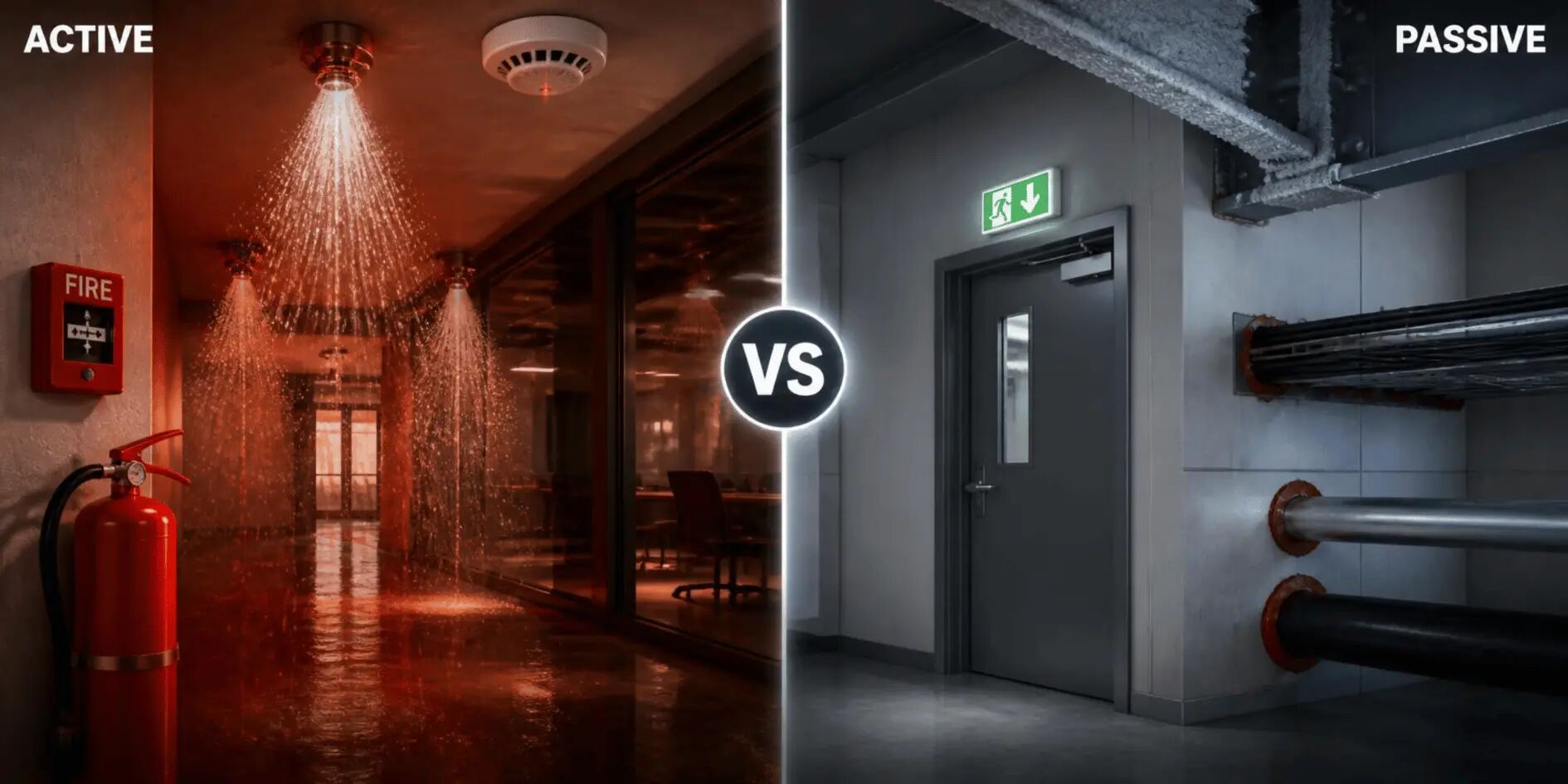

A fire protection system is designed to detect, notify, suppress, and contain fires. It covers everything from the alarm panel to the walls that hold the fire in a residential, commercial, or industrial facility. Based on these components, a fire protection system is divided into two types: active and passive. An active fire protection system detects, alarms, and fights a fire once it starts, through components such as detectors, sprinklers, and hydrants. In contrast, a passive fire protection system is built into the building's structure itself, such as fire-rated walls, floors, and doors that contain the fire and smoke where they started. Many owners treat only the first as their responsibility. In reality, the law holds them answerable for both.
In this article, we will discuss Active vs. Passive Fire Protection in detail. We will first understand what each one means. Then, discuss the key differences, where the two depend on each other, the laws that apply in India, and whether your facility needs both.
Why Buildings Need Both Active and Passive Fire Protection
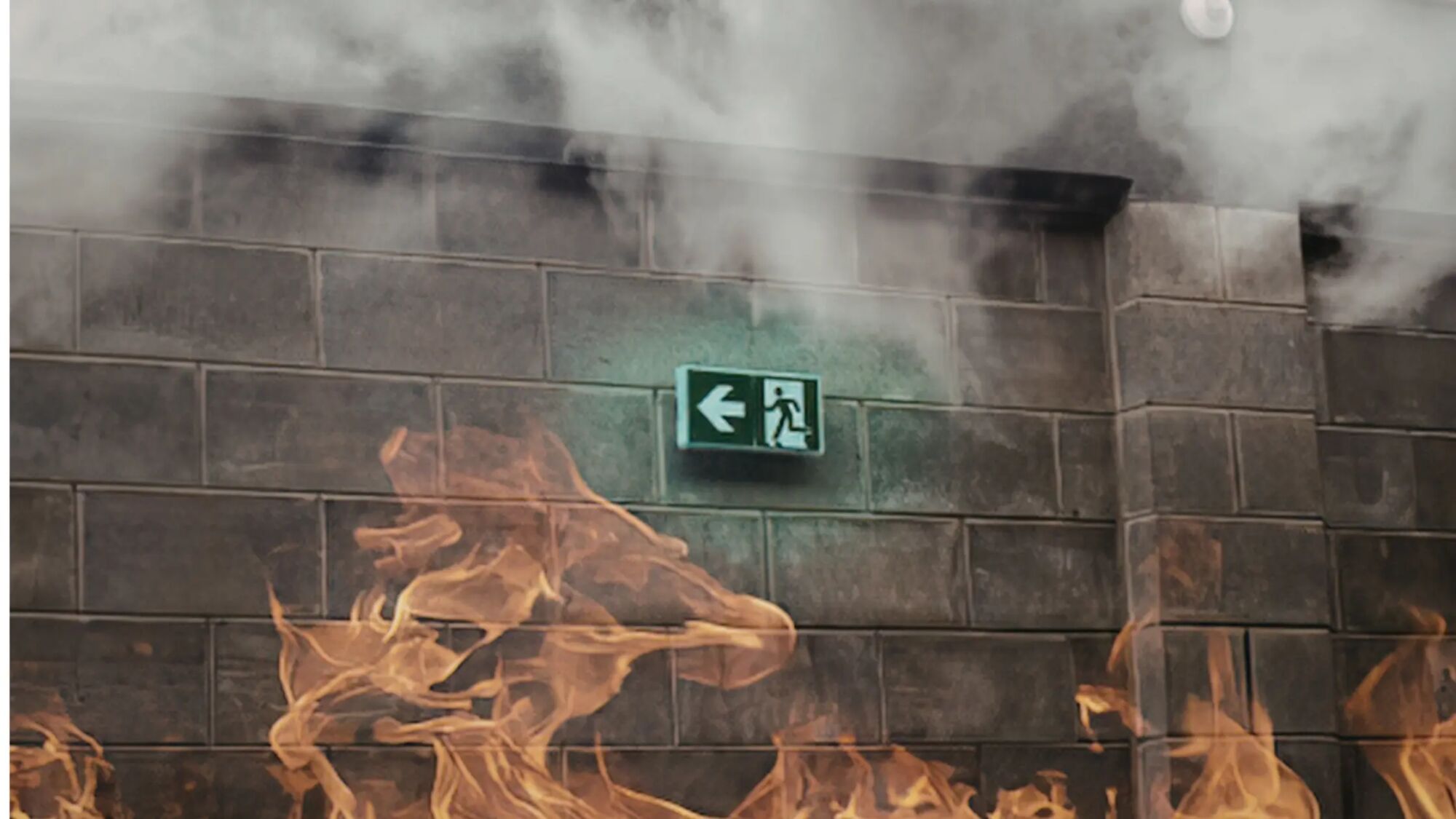
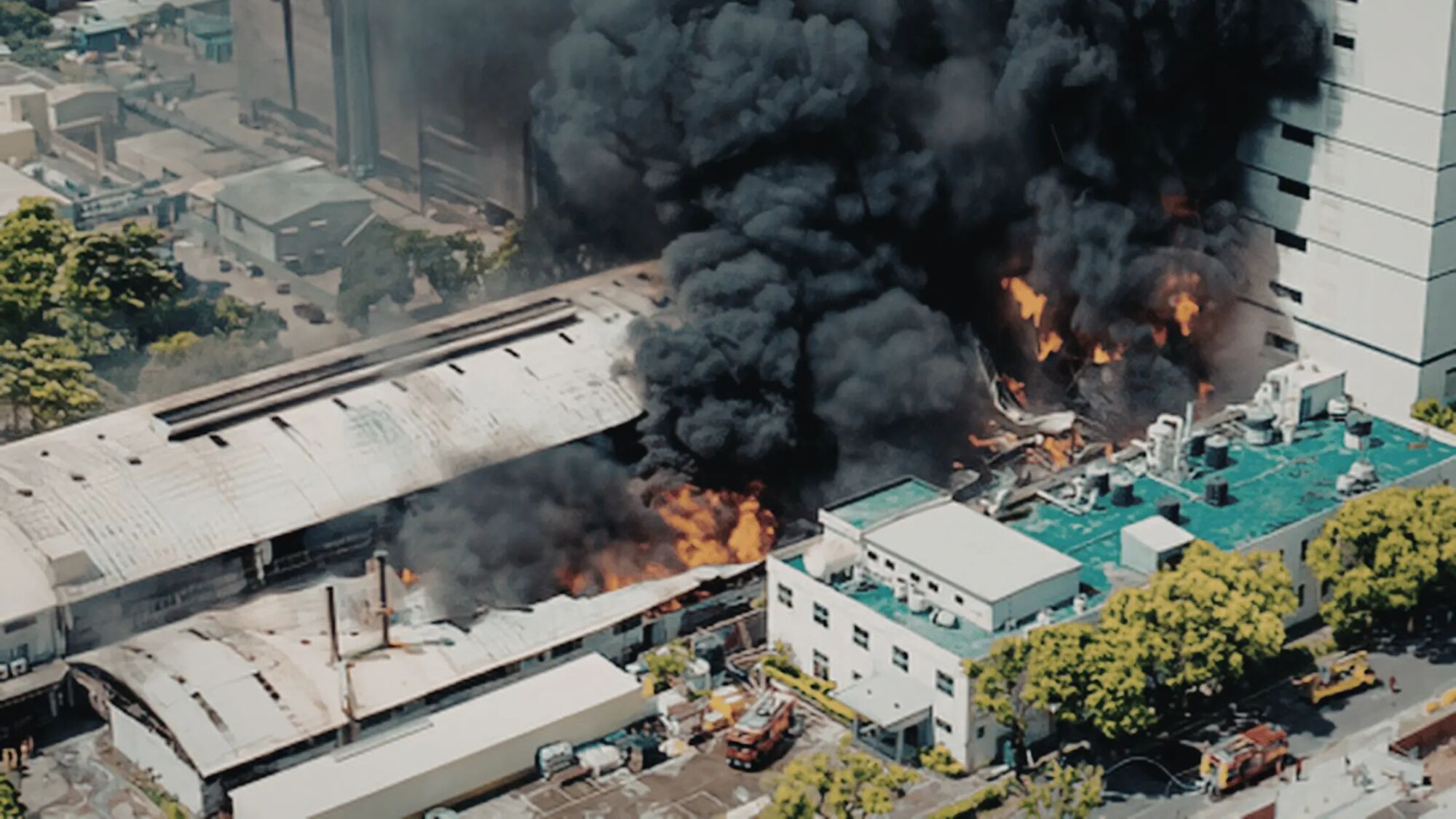
A fire inside a building creates two problems at the same time. The first is the fire itself, which has to be found and put out. The second is its spread, as the smoke and the heat move into the corridors and staircases, which are supposed to be an exit for the occupants. Active fire protection answers the first problem, and passive fire protection answers the second.
Neither side can do the other's job.
- Active systems fight the fire only where they reach and only while the power, the water, and the pump are available.
- Passive systems hold the fire inside a compartment for a fixed number of minutes, but nobody knows the fire has started, and no wall is built to hold beyond its rating.
Together, the walls keep the fire small enough to fight, and the sprinklers end it long before the rating runs out. That's why the standards ask for both.
Fire Safety Laws in India
In India, the National Building Construction Standards 2026 (NBCS 2026, SP 7:2026), which replaced the National Building Code of India 2016 on 30 April 2026, lists the detection and firefighting systems each occupancy needs in its Part F.210 The state fire laws hold the owner answerable for keeping both systems in good repair.1
In Maharashtra, the Maharashtra Fire Prevention and Life Safety Measures Act, 2006 defines the fire and life safety audit as the evaluation of every fire prevention and life safety measure the code requires, not the equipment alone.39 Under Section 45A, this audit must be conducted by a Licensed Fire and Life Safety Auditor for the buildings the Act lists.4 Licensed auditors like PowerTech hold that licence, and the audit we conduct covers the fire doors and the sealed shafts as closely as the pumps and the alarm panel.
Active vs. Passive Fire Protection Systems At A Glance
Below is a quick comparison of active and passive fire protection systems:
| Active Fire Protection | Passive Fire Protection | |
|---|---|---|
| Purpose | Detects, alerts, and puts out the fire | Holds the fire, smoke and heat where they started |
| Working | On a trigger: smoke, heat, or a person | The working starts independently from the day it is built in |
| Trigger / Human Intervention | Power, water, pressure, a person | Nothing, as long as it is intact |
| Typical Systems or Components | Detectors and alarm panel, sprinklers, hydrants and hose reels, extinguishers, gas suppression, fire pumps | Fire-rated walls and floors, fire doors, fire stopping, dampers, protected staircases, structural protection |
| Measured In | Coverage, flow, pressure, response time | Fire resistance in minutes, such as 120 minutes for a fire-rated door |
| Where it Sits | In plain sight: ceilings, corridors, pump room, control panel | Out of sight: inside walls and floors, above false ceilings, in shafts |
| Weakness | A switched-off panel, a closed valve, a pump that does not start | A wedged door, an unsealed cable opening, a broken door closer |
| Cost over the Building’s Life | Installed once, then a running cost for testing, refills, and AMC | Built in at construction; costs little to keep, a lot to add later |
Active Fire Protection
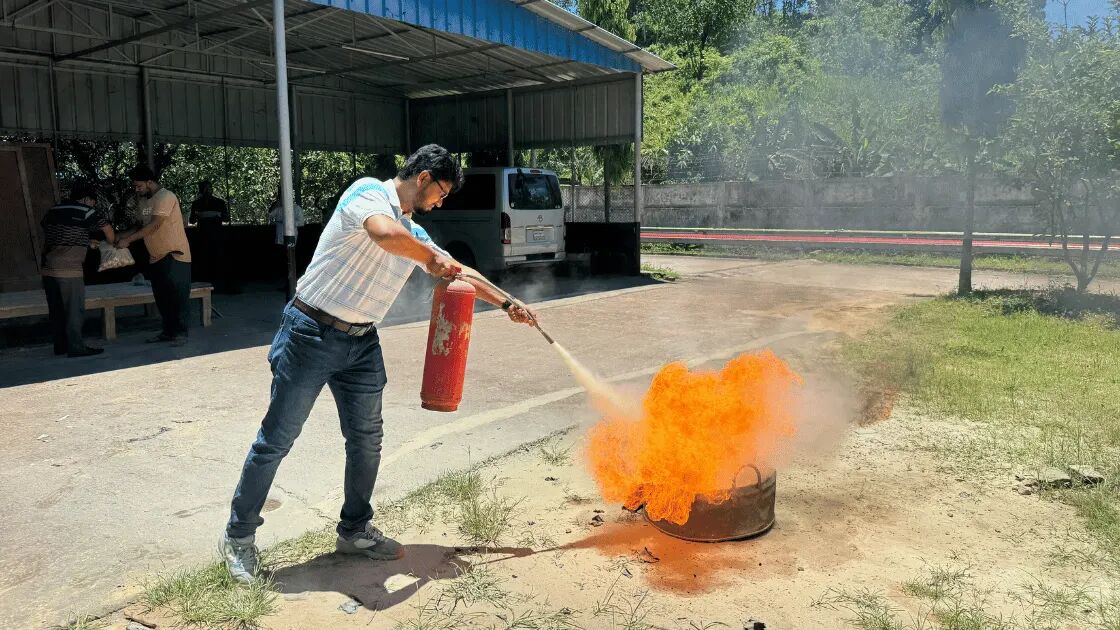
Active fire protection is nothing but the set of systems that respond when a fire starts. It is also written as AFP. Such systems detect the fire, warn the occupants, and put the fire out or hold it back until the fire brigade arrives. Each one needs a trigger or human intervention to start working: smoke to reach a detector, heat to open a sprinkler head, or a person to press a call point or pick up an extinguisher.
NBCS 2026 Part F sets out which of these systems a building must have, occupancy by occupancy and height by height. The Indian Standards then cover how each one is designed, installed and maintained.11 Below are the active systems found in most Indian buildings, with the standards that apply to them:
- Fire detection and alarm system: Smoke and heat detectors, manual call points and the alarm panel, covered by IS 2189, with the detectors to IS 11360 and IS 2175 and the panel to IS 15908.
- Automatic sprinklers: Heads that open one by one over the fire, designed and installed under IS 15105.
- Hydrants, hose reels and fire pumps: The internal hydrants and hose reels under IS 3844 and IS 884, the yard hydrants under IS 13039, the water supply under IS 9668 and the fire pumps under IS 15301.
- Portable fire extinguishers: Built to IS 15683 and selected, placed, and maintained under IS 2190.
- Gas-based suppression: Clean-agent systems for server rooms and panel rooms, where water cannot be used, under IS 15493.
As such, the entire active side rests on three things:
- The electricity to the panel and the pump
- The water in the tank and the pressure in the line
- The people who test them
An active system is only as good as its last test. That's why the codes of practice above carry maintenance schedules along with the design rules, and the routine pump runs and detector checks are part of the protection, not paperwork.
Passive Fire Protection
Passive fire protection includes the fire resistance systems built directly into the building itself. It is also written as PFP. It needs no alarm, no water, and no person. The typical passive fire protection systems are a fire-rated wall, floor, or door that does its job simply by staying intact. The goal is to keep the fire, its smoke and its heat inside the compartment where the fire started, for long enough to get everyone out and the fire brigade in.
Every passive element is rated in minutes through the furnace test in IS 3809, on three counts.11 It must stay standing (stability), keep the flames and hot gases on one side (integrity), and keep the far side cool enough not to start a second fire (insulation).7 NBCS 2026 Part F fixes the minutes each element needs, such as 120 minutes for fire separation walls and fire-rated doors, and up to 240 minutes for the columns and beams that carry more than one floor.8
Below are the passive elements found in most buildings:
- Fire-rated walls and floors that divide the building into compartments
- Fire doors and shutters, built and tested as complete doorsets under IS 3614, with the closer and the seals counted as part of the door
- Fire stopping and sealants that close the openings cut for cables, pipes and ducts.
- Fire dampers that shut inside the ducts where they cross a compartment wall
- Protected staircases, lobbies and shafts that keep the escape routes free of smoke
- Structural protection, such as intumescent coatings and boards, that keeps the frame standing in the heat
As such, the passive side has no on-off state and gives no warning. Its weak points are the people who alter the building construction: a contractor who drills through a rated wall for a new cable and never seals the hole, a security guard who wedges a fire door open, a false ceiling replaced without the fire stops behind it. Nothing in the building reports such damage.
One can say that the active side protects the building only when it works, whereas the passive side protects it only when it is left alone.
Key Differences Between Passive and Active Fire Protection
1. A Chain of Events vs. Presence
An active system works through a chain: smoke reaches the detector, the panel raises the alarm, the valve opens, the pump starts, and water reaches the head. Every link can fail on its own.
A passive element has no chain. A 120-minute wall protects the building at 3 a.m. on a holiday exactly as it does on the day of the audit, as long as nobody has cut a hole in it.
2. Size of the Fire vs. Reach of the Fire
The sprinklers and the hydrants decide how big the fire gets. The walls, floors, and doors decide how far it goes. As such, the active side protects the property first, and the passive side protects the escape routes first. A building with strong active systems and weak compartments may control the fire and still fill its staircases with smoke.
3. Missed Routines vs. Altered Buildings
The active side fails through a missed routine: a pump that was never run, a detector isolated after repeated false alarms, a valve left closed after a repair. The passive side fails through a change in the building: a renovation that removes a rated partition, a cable run that punctures a shaft, a wedge under a fire door.
That's why the AMC contractor cannot protect the passive side; only a permit system that seals every opening before the contractor leaves can.
4. Tested vs. Inspected
An active system can be tested. The auditor runs the pump, presses a call point, and measures the pressure at the topmost hydrant. A passive element can only be inspected. Nobody sets fire to a wall, so the auditor traces every compartment line on the drawing and then walks it, above the false ceiling, behind the panels, and inside the shafts, looking for the openings that appeared after the building was handed over.
5. Running Cost vs. Capital Cost
The active side costs money every year: testing, refills, spares, and the AMC. The passive side was paid for when the building went up and costs little to keep, but adding it later, such as a rated partition in a running office, costs many times more than building it in. In both cases, the state fire laws leave the responsibility with the owner, not with the contractor who installed or maintains the systems.
A Practical Example of Active and Passive Fire Protection Systems (What Happens When A Fire Starts)
Consider the electrical panel room on the fourth floor of a 30-metre office building, a high-rise under NBCS 2026. According to the BMC (Mumbai), 70 to 80% of city fires are caused by faulty electrical connections, so this is the most likely room for a fire to start.5 A loose termination on the busbar has been heating for months, and one evening the cable insulation above it catches fire.
Both sides go to work at once. In general, the first ten minutes run as follows:
- Active side: The smoke detector trips the alarm panel within a minute. The hooters sound on every floor, the hold-open fire doors along the corridor release, the gas-based suppression floods the room (sprinklers are not used over live panels), and the fire pump starts on the drop in header pressure to charge the hydrants for the fire brigade.
- Passive side: The panel room is a compartment of its own. Its 120-minute walls and its self-closing fire door keep the smoke inside, the damper in the exhaust duct shuts on its fusible link, and the cable shaft behind the panel, sealed at every floor, gives the fire no route upward. The occupants walk to the protected staircase through a corridor that is still clear.
Now remove one detail. If a contractor had left the shaft open after pulling a new cable last year, the smoke and the heat would climb to the floors above while every active system worked exactly as designed. On the other hand, suppose the smoke detector had been turned off after a false alarm a month ago; the door would still hold the fire, but nobody would know it had started. That’s why the experts say each side of a fire protection system, whether active or passive, has to be intact and working properly at the time of fire.
This is also why the electrical installation gets its own specialist in a fire audit. At PowerTech, the audit team includes a Chartered Electrical Safety Engineer (CESE), authorised by the Government of Maharashtra under Regulation 6 of the Central Electricity Authority (Measures relating to Safety and Electric Supply) Regulations, 2023, or CEA (MSES) Regulations 2023 for short.6 The CESE inspects the panels, the terminations, and the cable penetrations that a fire engineer would walk past. Check our Electrical Safety Audit page to know more.
FAQs
Q. Are fire extinguishers and fire dampers active or passive fire protection?
Extinguishers are active; a person has to pick one up and use it. Fire dampers are counted as passive, since they sit in the compartment wall and close on heat, but a damper that closes on a signal from the alarm panel depends on the active side too.
Q. Is passive fire protection mandatory in India?
In effect, yes. NBCS 2026 Part F sets the fire resistance ratings, and they become binding wherever the state fire law or the building bye-laws adopt them, as the Maharashtra Fire Act does. In Maharashtra, the owner must keep every fire prevention and life safety measure in good repair at all times, including the walls and doors.3
Q. How often is a fire safety audit required in Maharashtra?
For buildings, Section 45 of the Maharashtra Fire Act lists (above 30 metres and used as hotels, hospitals, business or mercantile buildings, or mixed occupancies; residential buildings above 70 metres; large oil and gas installations; and large hazardous factories); Section 45A requires the audit by a licensed auditor once every two years. Separately, Section 3(3) requires a Licensed Agency certificate on the maintenance of the systems twice a year, in January and July.3
Q. Does a fire safety audit check both active and passive fire protection?
Yes. The Maharashtra Fire Act defines the audit as the evaluation of every fire prevention and life safety measure the code requires, so a licensed auditor tests the pumps, hydrants, and alarms and inspects the compartments, fire doors, and sealed shafts in the same visit. An audit that reports on the equipment alone has covered half the building.
PowerTech: Licensed Fire & Life Safety Auditor for Active and Passive Fire Protection System Audits in India
PowerTech has 12+ years of audit experience auditing residential, commercial, and industrial facilities. We hold a Fire & Life Safety Auditor licence MF&ES/F&LSA/0029.
Both sides of fire protection in this article are checked in one visit: the active systems are tested with calibrated instruments, the compartments, fire doors, and sealed shafts are walked floor by floor, and the electrical installation is reviewed by our in-house Chartered Electrical Safety Engineer.
We offer the following audit and compliance services:
- Fire Safety Audit
- Electrical Safety Audit
- Energy Audit
- Thermography Audit
- Earth Pit Testing
- Power Quality Audit & Harmonic Study
- Energy Saving Contracts on BOT Model
Get In Touch
Tell us what has raised the question, whether it is the Section 45A due date, a fire NOC renewal, a renovation that touched the compartment walls, or an insurer's query, along with the building's type, height, use, and city. The qualified auditor named on the licence conducts the audit personally.
Contact our team of licensed auditors today to have both halves of your building's fire protection checked.
References
- (n.d.). Maharashtra Fire Prevention and Life Safety Measures Act, 2006. https\://lj.maharashtra.gov.in/en/document/the-maharashtra-fire-prevention-and-life-safety-measures-act-2006-text-as-on-7th-july-2025/
- (2026). Fire Protection Valve Guide: Selecting Supervised Isolation Valves for Sprinkler & Hydrant Systems (NBCS 2026). Poline Technologies. https\://www.poline.in/fire-protection-valve-guide-sprinkler-hydrant-systems
- (2006). The Maharashtra Fire Prevention and Life Safety Measures Act, 2006. Maharashtra Fire Prevention and Life Safety Measures Act. https\://indiankanoon.org/doc/181822843/
- (May 11, 2023). Maharashtra Fire Prevention and Life Safety Measures (Amendment) Act, 2023. Maharashtra Fire Prevention and Life Safety Measures (Amendment) Act, 2023. https\://firesafetynation.com/maharashtra-fire-prevention-and-life-safety-measures-amendment-act-2023/
- Bhalerao, S. (January 18, 2019). Mumbai: 70 to 80% fires due to faulty electrics, says BMC. The Indian Express. https\://indianexpress.com/article/cities/mumbai/mumbai-70-to-80-fires-due-to-faulty-electrics-says-bmc-5543949/
- Government of Maharashtra, Industries, Energy and Labour Department. (September 20, 2019). Guidelines for Authorising Chartered Electrical Safety Engineers (CESE), Government Resolution No. Misc 2019/C.R.96/Energy-5. Office of the Chief Electrical Inspector, Maharashtra. https\://www.ceimah.in/uploads/cie/gallery/media/Guidlines%20for%20CESE%2020092019.pdf
- (n.d.). IS 3809:1979 Fire resistance test for structures. https\://infralens.in/code/IS-3809-1979
- (2026). Free Passive Fire Protection Compliance Checklist for NBCS 2026 Part F. Wedge Industries Limited. https\://wedgeinsulation.com/free-passive-fire-protection-checklist-nbcs-2026-part-f/
- Government of Maharashtra. (2025). The Maharashtra Fire Prevention and Life Safety Measures Act, 2006 (as amended, text as on 7 July 2025). Directorate of Maharashtra Fire & Emergency Services. https\://mahafireservice.gov.in/directorate/fire-act/2006/Maharashtra%20Fire%20Prevention%20and%20Life%20Safety%20Measures%20Act,%202006..pdf
- Bureau of Indian Standards. (2026). National Building Construction Standards 2026 (SP 7:2026), Part F: Fire and Life Safety. Hosted by the Directorate of Fire and Emergency Services, Government of Goa. https\://dfes.goa.gov.in/wp-content/uploads/2026/05/sp7_2026_nbcs-212-1480.pdf
- Bureau of Indian Standards. (1979). IS 3809: Fire Resistance Test of Structures (First Revision). Public archive, law.resource.org. https\://law.resource.org/pub/in/bis/S03/is.3809.1979.pdf
Article Scores
[IMAGE 1 HERE — upload it in Admin → Media, click “Copy article image code”, and replace this line]
[IMAGE 2 HERE — upload it in Admin → Media, click “Copy article image code”, and replace this line]
Leave a Reply
Your email address will not be published. Comments appear after we have approved them. Required fields are marked *.