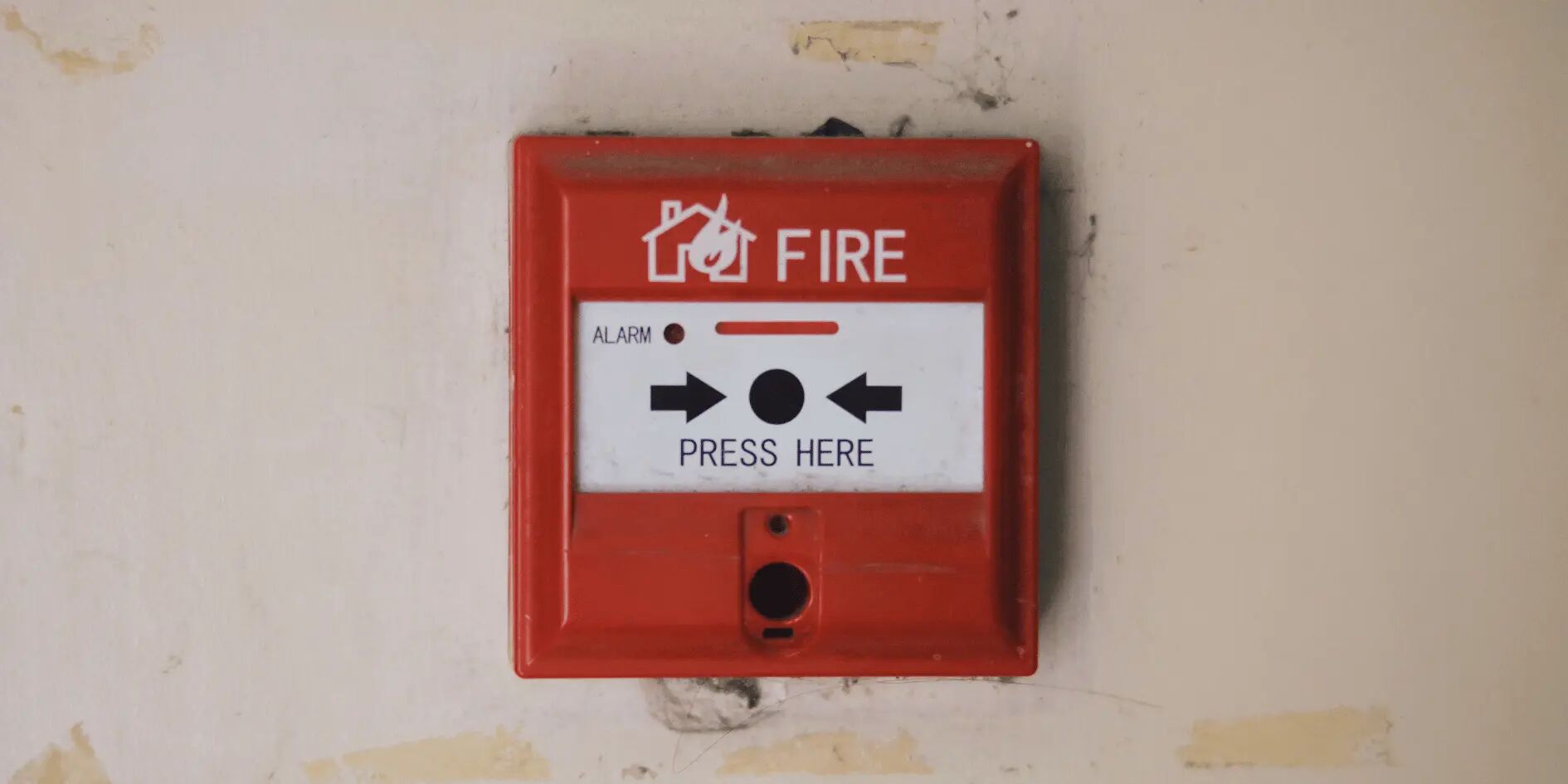

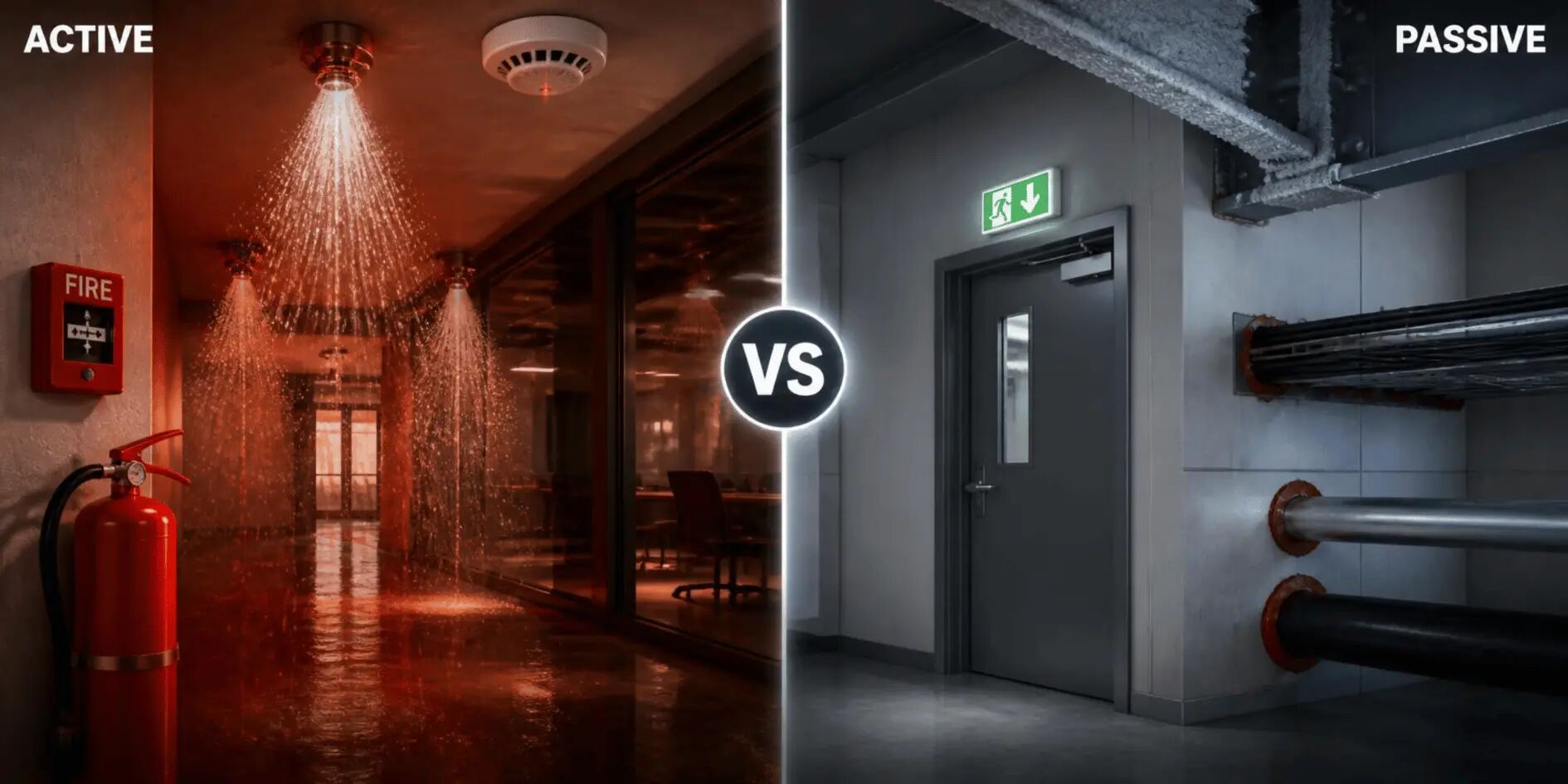
A typical fire detection system includes a set of monitoring devices that detect the presence of fire. Many refer to it as an alarm system that detects and responds to events reported by permanently installed automatic and manual monitoring devices. It is an integral part of an active fire protection system.
In this article, we will discuss Fire Detection Systems in detail. Let us understand how a fire detection system works, the most common types of fire detectors, the difference between conventional and addressable systems, how they are tested and maintained, and the Indian laws and standards which apply to them.
What is Fire Detection System?
A fire detection system is a set of devices which sense the first signs of a fire, such as smoke and heat, and report the same to a fire alarm panel. Together with the alarm system, it is also known as an automatic fire detection and alarm system, as per the National Building Code of India, NBCS 2026 (SP 7:2026).1 It works in two ways: automatic and manual. The automatic detectors, such as smoke and heat detectors, watch the building round the clock, and the manual call points near the exits let any person report a fire by hand. The hooters and the smoke extraction fans are dependent on this first signal for their activation.
Below are its main components:
- Automatic detectors fixed on the ceilings
- Manual call points near the staircases
- The detection circuits, called zones in a conventional system and loops in an addressable one
- The fire alarm panel with its standby battery
In Maharashtra, only a Licensed Fire and Life Safety Auditor can conduct the fire audit under Section 45A of the Maharashtra Fire Prevention and Life Safety Measures Act, 2006.2 This licence comes from the Directorate of Maharashtra Fire & Emergency Services. PowerTech is one of the licensed auditors, and the audit we conduct checks whether the detectors and the call points really report to the panel.
How a Fire Detection System Works
Every fire gives off a few signs before it grows. That's why a typical fire detection system includes different types of detector for sensing each sign. In general, there are four such signs:
- Smoke, which is usually the first to appear
- Heat
- Flame, in the form of light radiation
- Gases such as carbon monoxide
Hot smoke and gases generally travel upwards and collect at the highest part of a room, which is the reason why the detectors are fixed on the ceiling.3 Once a detector senses smoke or heat beyond its set limit, it sends a signal to the fire alarm panel, and the same thing happens when a person breaks the glass of a manual call point. Then, the panel shows the zone, or the exact device in an addressable system, from where the signal has come. The job of the detection side ends here. After that, the hooters and the public address system take over.
To learn more about active fire protection in detail, please read our article: What is Active Fire Protection? Meaning, How It Works, Types of Active Fire Protection Systems, and More.
7 Most Common Types of Fire Detectors
Fire detectors are available in the following seven types, all of which are covered in IS 2189:2026, the Indian Standard for fire detection and alarm systems.34
1. Smoke Detectors
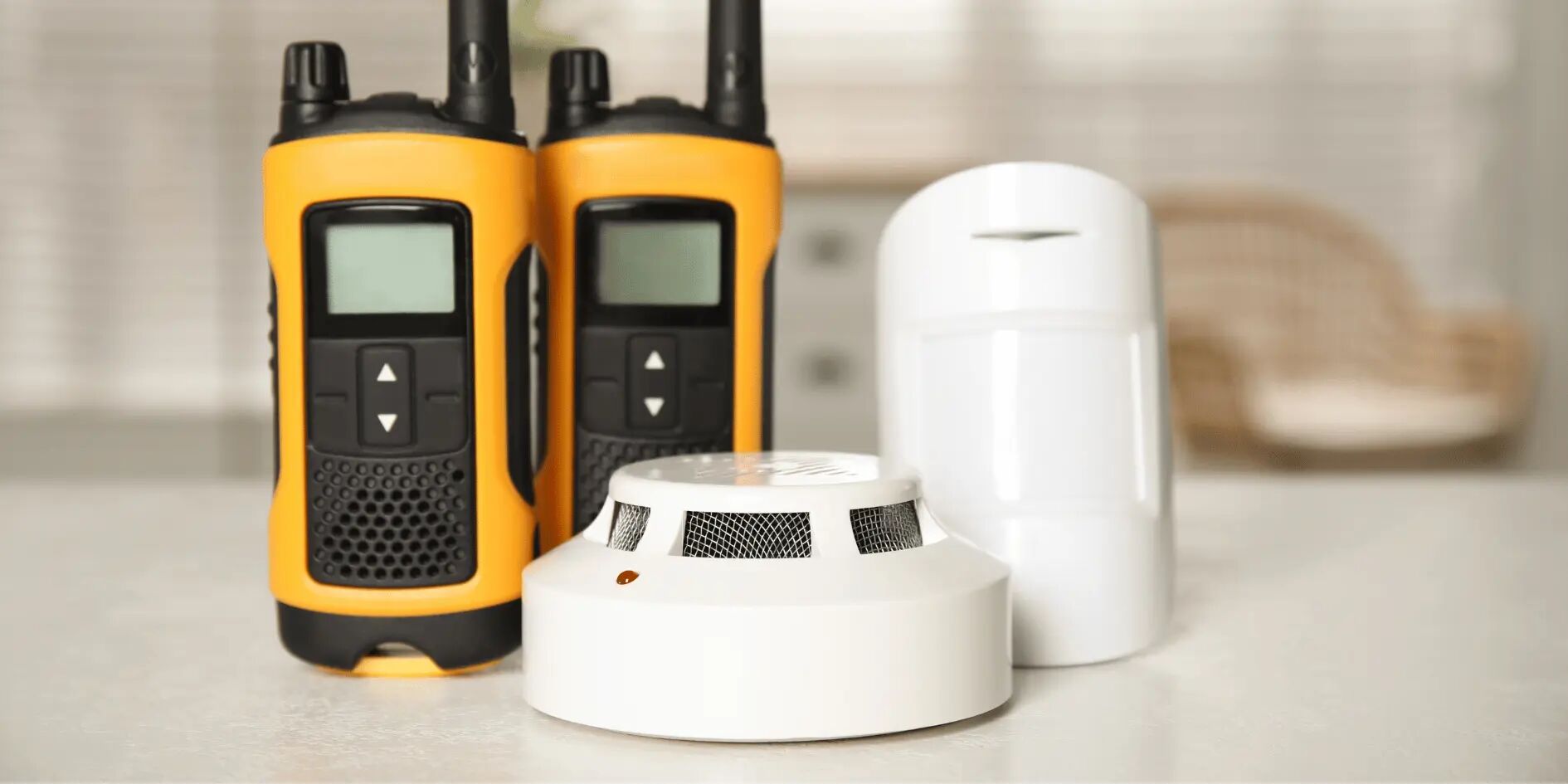
The smoke detector is the most common type. Its optical version reads the light scattered by smoke and responds quickly to a smouldering fire, and the ionisation version, which holds a small radioactive source as per IS 2189:2026, is quicker on clean-burning fires.3 As the first choice for life safety, it is ideal for offices and hotel rooms, along with the escape corridors.
2. Heat Detectors
A heat detector responds when the temperature crosses a fixed value or rises faster than a set rate. It is slower than a smoke detector. That's why it is best suited for kitchens and diesel generator (DG) rooms where smoke is normal, and its line type, commonly known as the linear heat sensing (LHS) cable, for cable trays and conveyors.
3. Flame Detectors
A flame detector reads the ultraviolet (UV) or infrared (IR) radiation of a flame, so it needs a clear line of sight. Sunlight and arc welding can confuse it. As such, the combined UV/IR models are used in order to reduce such false alarms, and they are ideal for high-ceiling warehouses and the areas where fuels or solvents are handled.
4. Multi-criteria and Carbon Monoxide Detectors
A multi-criteria detector carries more than one sensor, such as smoke with heat, and weighs the readings together, which helps in reducing the false alarms. The carbon monoxide (CO) detector is a related type. It is ideal for the rooms where people sleep, but as per the code, it can not catch the early overheating of electrical cables, where an aspirating detector does better.3
5. Beam Detectors
A beam detector throws a beam of light across a large hall to a receiver, and the smoke rising through it weakens the signal. One set can span about 100 metres. For ceilings above 10 metres, IS 2189:2026 does not allow the point type smoke or heat detectors, which makes the beam detector ideal for warehouses and atriums.3
6. Aspirating Smoke Detectors
An aspirating detector draws air from the room through a network of small pipes, so it can catch a trace of smoke which a ceiling detector would miss. It suits server rooms and data centres. A similar unit inside the air-conditioning ducts, known as the duct detector, tells the panel to stop the fans.
7. LPG and PNG Gas Leak Detectors
Such detectors do not sense a fire at all. They sense the cooking gas leaked from a cylinder or a pipeline, and warn the occupants before it can catch fire or explode. Ideal for the kitchens of hotels and hospitals, as well as the housing societies with piped gas.
Please note that no single detector suits every area of a building, and the code itself advises a combination of different types.3
Quick Comparison Table of All Fire Detector Types
| Detector | Senses | Warning | Main Limitation | Application |
|---|---|---|---|---|
| Smoke | Smoke particles | Fast | False alarms from dust | Offices, hotel rooms |
| Heat | Temperature | Slow | Not for life safety | Kitchens, DG rooms |
| Flame | UV or IR radiation | Very fast | Needs line of sight | High-ceiling warehouses |
| Multi-criteria and CO | Smoke with heat, or CO | Fast | CO misses cable overheating | Sleeping areas |
| Beam | Smoke across a beam | Moderate | Needs firm mounting | Warehouses, atriums |
| Aspirating | Traces of smoke | Earliest | Needs a pipe network | Server rooms |
| Gas Leak | Leaked LPG or PNG | Before a fire | Does not sense fire | Commercial kitchens |
Please note that the speed ratings above are relative. The final choice depends on the risk and the ceiling height of the area, for which IS 2189:2026 carries a detector selection guide.3
Conventional vs. Addressable Fire Detection Systems
In a conventional system, the detectors of one area are wired together on a single circuit called a zone, and when any of them operates, the panel only shows the zone, so someone has to walk through it to find the exact spot. As per IS 2189:2026, a zone can hold up to 20 detectors. It can cover up to 2,000 square metres, so it suits small buildings such as a clinic or a small office.3
On the other hand, every detector and call point in an addressable system carries its own address on a loop. The panel talks to each device. As such, it shows the exact detector which has operated and also the health of every device, which makes it the smarter choice for large and complex buildings such as hotels, hospitals, IT parks, etc.
IS 2189:2026 also covers the wireless and hybrid systems, which are useful in heritage buildings and retrofit projects where new cabling is difficult.3
Fire Detection System Maintenance and Testing
In general, a fire detection system stays silent for years, so a dead detector or a weak battery goes unnoticed until the day it is needed. That's why IS 2189:2026 lays down the following routine for the user:
- Daily: Check that the panel shows normal operation, and log every fault.
- Weekly: Review the events of the past week and confirm that each one was resolved.
- Quarterly: Test the batteries and the hooters, and operate one device in every zone.
Through the contractor, get the detectors tested for operation and sensitivity, and replace the ones found outside the approved range.3
In Maharashtra, the law adds its own checks. The licensed agency which maintains the system certifies it twice a year, in January and July, and for the buildings listed in Section 45 of the Act, such as the hotels and hospitals above 30 metres, a Licensed Fire and Life Safety Auditor conducts an audit once every two years.25
To learn more about the audit, please read our Fire Safety Audit page.
Fire Detection System Laws and Standards in India
In India, the rules for a fire detection system come from three places:
- NBCS 2026 (Part F): Decides which buildings need a detection and alarm system, as per their occupancy and height, and becomes binding through the state fire law or the fire NOC conditions.1
- IS 2189:2026 and the IS/ISO 7240 series: The first covers the design and upkeep of the system, and the second covers the detectors and other components as products.3
- Maharashtra Fire Act (State-Specific Laws): For the Section 45 buildings, Section 3(3A) and the Rules amended in June 2025 ask for an IoT-based automated continuous monitoring system (ACMS), which reports the detector and panel status to a cloud portal every minute.56 The Certificate of Compliance (Form 'V') comes only from a licence holder such as PowerTech (licence no. MF&ES/F&LSA/0029).26
So, it is better to book a fire safety audit before the fire NOC renewal or after any fit-out, as well as when the panel keeps showing faults.
Fire Detection Systems: Key Things to Keep in Mind
Before you finalise or upgrade a fire detection system, keep a few things in mind. Let the risk and the ceiling height of each area decide the type of detector, and the size of the building decide the type of panel. Most of the failures come later. A detector gets covered during painting work, or a zone gets switched off because of nuisance alarms, and it stays that way for months, which is why the log book and the quarterly tests should never be skipped.
Since 2014, the engineers at PowerTech have been auditing buildings and factories from their offices in Pune, Mumbai and Nashik, and the auditor named on our Fire & Life Safety Auditor licence (MF&ES/F&LSA/0029) personally conducts the fire audit, right from the call points to the panel. Contact our team of licensed auditors today to get the detection system of your building checked, and expect a reply within one working day.
References
- (April 30, 2026). National Building Construction Standards 2026 (SP 7:2026), Part F: Fire and Life Safety. Bureau of Indian Standards (copy hosted by the Directorate of Fire and Emergency Services, Goa). https://dfes.goa.gov.in/wp-content/uploads/2026/05/sp7_2026_nbcs-212-1480.pdf
- (2023). The Maharashtra Fire Prevention and Life Safety Measures Act, 2006 (Mah. III of 2007), as amended. Directorate of Maharashtra Fire and Emergency Services. https://mahafireservice.gov.in/directorate/fire-act/2006/Maharashtra%20Fire%20Prevention%20and%20Life%20Safety%20Measures%20Act,%202006..pdf
- (March 2026). IS 2189:2026, Selection, Installation and Maintenance of Automatic Fire Detection and Alarm System, Code of Practice (Fifth Revision). Bureau of Indian Standards (copy hosted by the National Safety Council of India). https://nsc.org.in/assets/img/safetyconnect/pdf/FIRE-DETECTORS.pdf
- (2026). IS 2189:2026, Know Your Standards record (superseding IS 2189:2008). Bureau of Indian Standards. https://www.services.bis.gov.in/php/BIS_2.0/bisconnect/knowyourstandards/Indian_standards/isdetails/NjY0ODE=
- (May 11, 2023). The Maharashtra Fire Prevention and Life Safety Measures (Amendment) Act, 2023 (Mah. XXIV of 2023). Maharashtra Government Gazette, via the Directorate of Maharashtra Fire and Emergency Services. https://mahafireservice.gov.in/directorate/fire-act/2023/English.pdf
- (June 12, 2025). The Maharashtra Fire Prevention and Life Safety Measures (Amendment) Rules, 2025, Notification No. MFS-2023/C.R.370/UD-14. Urban Development Department, Government of Maharashtra, via the Directorate of Maharashtra Fire and Emergency Services. https://mahafireservice.gov.in/directorate/fire-act/2025/Act%20to%20Rules%20(Amended)%20English.pdf

Leave a Reply
Your email address will not be published. Comments appear after we have approved them. Required fields are marked *.