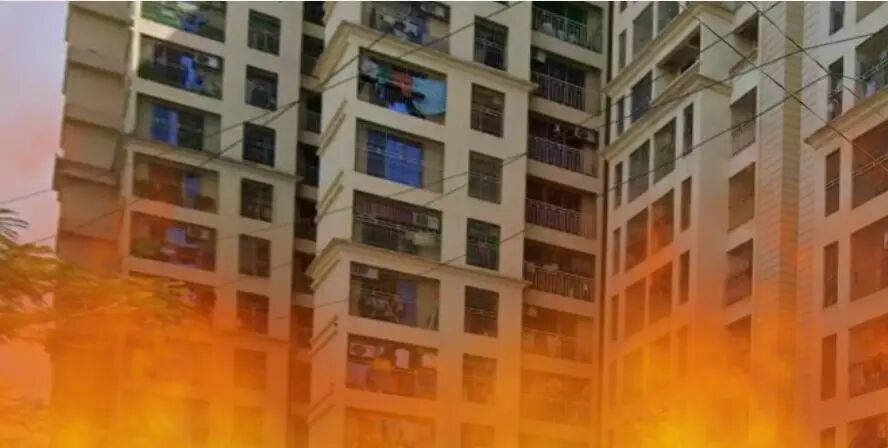

The fire at the 14-storey Imperial Heritage residential building in Achole, Nalasopara East, on Tuesday night (13 October 2026) has once again highlighted the importance of electrical safety, fire prevention, and emergency preparedness in housing societies. As reported by the Times of India, two women died of suffocation and more than 25 residents were rescued, and officials suspect a short circuit triggered the fire.
The fire started on the ninth floor of the B wing and spread up to the 14th floor, with thick smoke trapping residents on the upper floors. While residential buildings are designed with electrical installations and firefighting systems, these systems need regular inspection, testing, maintenance, and corrective action to remain effective.
Many housing societies focus on housekeeping, security, lifts, and other routine maintenance activities. However, electrical safety and fire protection sometimes receive attention only after a fault, inspection notice, or fire incident.
A professional Electrical Safety Audit and Fire & Life Safety Audit for residential societies can help identify potential hazards before they result in injury, property damage, or disruption.
At PowerTech, we encourage housing societies, apartment complexes, high-rise residential buildings, and facility managers to adopt a proactive approach to safety.
Why is electrical safety important in residential societies?
Electrical faults can arise from overloaded circuits, loose connections, deteriorated insulation, unsuitable electrical accessories, improper protection, and inadequate maintenance.
During building construction, electrical infrastructure is designed based on the anticipated connected load and applicable design requirements. Over time, residents may install additional air conditioners, geysers, microwave ovens, dishwashers, induction cooktops, washing machines, and other electrical appliances.
The original installation may not always have been assessed for these subsequent changes.
The key questions are:
- Can the existing electrical wiring safely carry the present load?
- Are the cable sizes suitable for the connected load and installation conditions?
- Are MCBs and RCCBs correctly selected and functioning?
- Are distribution boards, terminals, and connections showing signs of overheating?
- Is the earthing system adequate and properly maintained?
- Are fixed electrical installations using cables suitable for the intended application?
An electrical safety audit for a housing society or residential flat helps identify these concerns and recommend appropriate corrective measures.
To learn more about electrical safety in housing societies in detail, please read our article: Electrical Safety in Residential Housing Societies.
Use of suitable electrical cables and standard materials
Electrical cable selection should never be based on price alone. The conductor, insulation, current-carrying capacity, installation method, and applicable standards must be considered.
For example, flexible cables intended for particular applications should not automatically be used as fixed wiring in place of cables suitable for permanent installations. The applicable requirements of the National Electrical Code of India, relevant IS standards, and the intended installation must be considered.
Similarly, MCBs, RCCBs, distribution boards, switches, sockets and other electrical accessories should be selected from reliable sources and installed correctly.
Saving money on electrical materials can prove costly if it compromises electrical safety.
Common electrical safety audit observations in residential buildings
A detailed electrical safety audit may cover the following, depending on the agreed scope:
- Main LT panels, electrical distribution boards and meter rooms
- Cable sizing, condition and visible signs of deterioration
- Loose connections, overheating and electrical hot spots, often located through a thermography audit
- MCB and RCCB selection, condition and functional testing
- Earthing continuity and applicable earthing measurements, including earth pit testing
- Earth fault loop impedance and protective device verification, where applicable
- Insulation resistance testing, where appropriate
- Common-area lighting, pumps, electrical equipment and DG installations
- Electrical safety in individual flats, where access and scope permit
- Overloading, unauthorised modifications and poor electrical practices
Testing should be carried out using suitable instruments by competent personnel, following safe isolation procedures wherever required.
Fire safety audit for residential societies and high-rise buildings
Fire safety involves much more than installing fire extinguishers. All relevant fire protection and life safety arrangements must be inspected and maintained.
A professional Fire & Life Safety Audit for a residential building may assess:
- Fire pumps, jockey pumps and pump control panels
- Fire hydrant systems and hose reels
- Automatic sprinkler systems, where installed or required
- Fire alarm and detection systems
- Portable fire extinguishers and their service status
- Staircases, corridors and emergency exits
- Refuge areas and access to designated escape routes
- Fire doors, signage and emergency lighting
- Fire brigade access and access to firefighting equipment
- Emergency plans, evacuation procedures and resident awareness
- Maintenance records and closure of previous audit observations
A fire pump that fails to start, a defective control panel or a blocked escape route may seriously affect emergency response. Therefore, inspection must be supported by appropriate functional testing, maintenance and corrective action.
To learn more about how an audit checks these systems in detail, please read our article: The Difference Between Active and Passive Fire Protection: Systems, Failures, and How an Audit Checks Both.
Why blocked passages and refuge areas are dangerous
During a fire, smoke can spread rapidly and make escape routes difficult to use. Items stored in staircases, corridors or refuge areas can obstruct evacuation and delay emergency response.
In the Nalasopara fire, police reported that the lifts were not working due to the fire, and rescuers had to break open doors to reach trapped residents. In such a situation, staircases and refuge areas are often the only way out.
Smoke inhalation can be life-threatening. Safe evacuation depends on suitable escape routes, functional emergency systems, clear signage and effective emergency procedures.
Housing societies should regularly check that escape routes remain unobstructed and that refuge areas are used and maintained in accordance with applicable requirements.
Who is responsible for safety in a housing society?
A residential society may not have a dedicated safety department like an industrial facility. Responsibilities are generally distributed among the managing committee, facility manager, security team, maintenance contractors, residents, and other relevant parties.
The society should establish clear responsibilities for:
- Routine inspection of electrical and fire safety systems
- AMC and preventive maintenance
- Testing of fire pumps, alarms and other relevant equipment
- Reporting and correcting electrical defects
- Maintaining inspection and maintenance records
- Organising fire drills and resident awareness activities
- Tracking audit observations until corrective actions are completed
An independent safety audit provides a structured assessment of risks and helps the managing committee prioritise corrective work.
Is a fire safety audit mandatory for residential buildings in Maharashtra?
The Maharashtra Fire Prevention and Life Safety Measures Act, 2006, as amended in 2023, contains provisions for Fire & Life Safety Audits for specified building categories.
Under Section 45A, the statutory audit requirement covers the occupancies specified in Section 45. The amended provisions include residential buildings exceeding 70 metres in height. For buildings covered by the provision, the audit is required within the specified initial period and subsequently once every two years. The applicable certificate must be furnished to the designated authority as prescribed. (Source: Maharashtra Fire & Emergency Services, official legislation and rules)
The applicability of statutory requirements should be checked against the current Act, Rules, applicable notifications, and the specific building's category and height. Societies should consult a licensed Fire & Life Safety Auditor for confirmation.
Irrespective of whether a particular building falls within the statutory audit category, regular inspection and maintenance of electrical and fire protection systems remain important safety practices.
To learn more about the statutory audit and who may conduct it, please read our Fire Safety Audit page.
What happens after the audit?
An audit report alone cannot make a building safe. Its value depends on the quality of corrective action.
The society should:
- Understand the identified observations and associated risks.
- Prioritise urgent and high-risk defects.
- Assign responsibility and timelines for rectification.
- Engage competent agencies for repairs and modifications.
- Verify completion and retain supporting records.
- Continue periodic inspection and preventive maintenance.
Where necessary, the society should obtain expert assistance to determine suitable corrective measures and verify their implementation.
Electrical and fire safety audit services by PowerTech
PowerTech provides professional engineering and safety assessment services for residential, commercial, and industrial facilities.
Our relevant services include:
- Electrical Safety Audit for housing societies and residential buildings
- Fire & Life Safety Audit for residential and high-rise buildings
- Electrical installation inspection and testing
- Earthing and electrical protection assessment
- Inspection of fire protection and firefighting systems
- Identification of electrical and fire hazards
- Technical reporting and recommendations for corrective action
Our objective is to help clients understand existing risks and take practical steps towards safer buildings.
Book an electrical or fire safety audit for your housing society
Do not wait for an electrical fault or fire incident to discover a safety gap.
Contact PowerTech to discuss an Electrical Safety Audit or Fire & Life Safety Audit for your residential society.
- Email: info@ptesolutions.in
- Contact: +91 9226936163
- Website: www.ptesolutions.co.in
PowerTech Energy Solutions. Practical engineering solutions for electrical safety, fire safety, and risk reduction.


Leave a Reply
Your email address will not be published. Comments appear after we have approved them. Required fields are marked *.